Thursday, 28 March 2013

Google Introduces Keep, a Simple but Powerful Note-Taking App

It first surfaced a few days ago, but Google is already launching it, the note-taking app Keep is here. It's tied into Google Drive, but it is its own app, both online and on Android.

As expected, it's a relatively simple app, you can take simple notes, make lists, but there are a couple of more advanced features as well.

"With Keep you can quickly jot ideas down when you think of them and even include checklists and photos to keep track of what’s important to you," Google explains.

"Your notes are safely stored in Google Drive and synced to all your devices so you can always have them at hand," it adds.

"If it’s more convenient to speak than to type that’s fine—Keep transcribes voice memos for you automatically. There’s super-fast search to find what you’re looking for and when you’re finished with a note you can archive or delete it," Google added.

For now, Keep can store notes, lists and photos. It works on the web, on mobile devices too thanks to a flexible design, but there's also an Android app, for both phones and tablets.

The key to all of this is speed, any note-taking app has to be first and foremost fast. In fact, it has to be faster than grabbing a pen and jotting something down.

That's simple enough on the web, but it's harder and more important on mobile devices. The app works well enough though, there's a widget so you can take a note very fast. In fact, there's even a lockscreen widget, on devices running Android 4.2 and above.

There's also plenty of potential, Google could add more things you can "keep." For now, the app is compared to Evernote, though it's got fewer features, but it could evolve into something rather different, when Google decides to enable users to share their notes.


Read more

Google Chrome 26 Lands with Intelligent Cloud Spell Checker

Google Chrome 26 has hit the stable channel. It's a bit surprising actually, since Chrome 26 has only been in the beta channel for a month. Chrome releases usually spend six weeks in each channel before graduating.


Perhaps the fast cycle can be explained by the short list of new features, though this list is usually short.

The only notable new feature is the spell checker which has gotten a big boost, particularly thanks to Google's cloud spell checker, the same one used in Docs and Search.

If you enable the "Ask Google for suggestions" feature, Chrome will use Google's online spell checking engine which comes with advanced features such as grammar and homonym checking.

Google uses machine learning technology for the online checker and since it has the entire web indexed, it's almost never wrong and very rarely misses a mistake.

The new spell checker can understand context, it knows whether you wanted to use 'ad' or 'add' and will offer suggestions accordingly. If you've used Docs before you'll know how powerful it is, if you haven't, you'll find out soon enough.

The only caveat is that, obviously, for it to work everything you type has to be sent to Google's servers. Google doesn't store any of this or uses it any way except to check your spelling, but if you don't trust Google, this could be an issue.

Even if you don't enable the cloud spell checker, you can still benefit the addition of beefed up dictionaries for all languages as well as support for Korean, Tamil and Albanian.

What's more, your custom dictionary can now be synced between browsers so you won't have to add words you commonly use more than once. You can also edit the dictionary to remove words you no longer use or manually add a batch of them.
Read more

Wednesday, 27 March 2013

1337Day Inj3ct0rs Official domain hacked - 1337day.com Hacked

1337day official website hacked by  hackers from Morocco with the code names  SQL_Master and Z0mbi3_Ma

With this message in the deface:


Inj3ct0rs Fuck3d !
Hello all ! Today 1337day hacked ! not just for fun or laughing , but sombody from ur team thinks he's the best hacker in the world .
u are sure of ur security :) ?? and u believes no one can hack ur primary domain ( 1337day.com )
and somebody thinks u are the heros :)
now u are been fucked by us , so don't say bullshits again please ;) .
Ass thinks he's a horse :D
We are : SQL_Master and Z0mbi3_Ma


Read more

Sunday, 24 March 2013

Yahoo, LinkedIn, Twitter Accounts Vulnerable to Session Fixation Attacks – Video


Security researcher Rishi Narang has identified a vulnerability that could be exploited by cybercriminals to hijack accounts belonging to Microsoft, Twitter, LinkedIn and Yahoo users. Google and Facebook customers are not impacted by the flaw.

According to the expert, the vulnerability, which can be leveraged to launch session fixation attacks, is caused by an issue with the management of cookies and sessions.

If an attacker can intercept authentication cookies, he can use them to hijack the account because although an expiry date is set, they’re still valid even after the customer logs out.

“The cookie/session ID for an authenticated session is available even after the session has been terminated. There are examples where cookies can be accessible to hijack authenticated sessions,” Narang explained.

“And these cookies are days (sometimes months) old. As a result, someone can successfully access accounts that belong to individuals from different global locations. Even if they would have logged-in/logged out many a times, theirs cookie would still be valid.”


Read more

Sunday, 17 March 2013

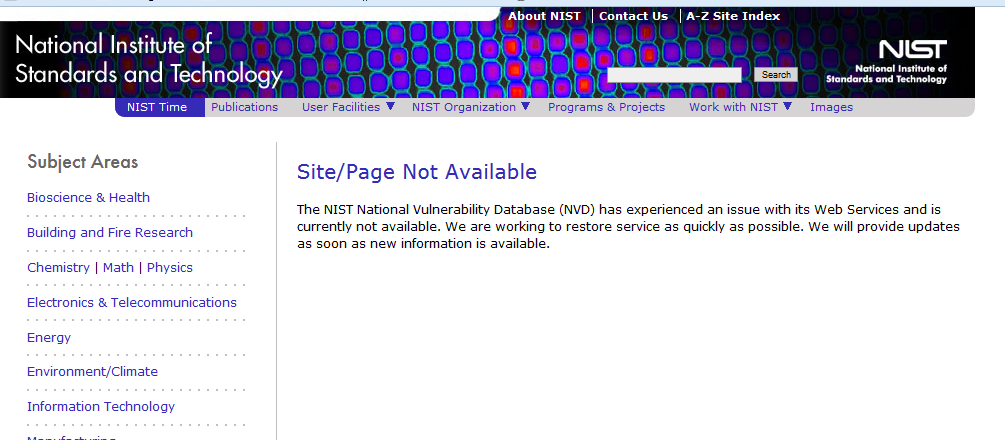
NIST National Vulnerability Database Down, Malware Identified on Two Web Servers

The National Vulnerability Database (NVD) and several other websites operated by the National Institute of Standards and Technology (NIST) have been inaccessible for the past few days.

It turns out that NIST's systems have been hacked. More precisely, the sites have been taken down after malware was identified on a couple of web servers.

Security expert Kim Halavakoski has contacted NIST representatives in an attempt to find out why the NDV is unavailable.

“The National Vulnerability Database public-facing Web site and several other NIST-hosted Web sites are currently unavailable due to discovery of malware on two NIST Web servers,” NIST representatives wrote in an email to Halavakoski, which he posted on his Google+ profile.

“On Friday March 8, a NIST firewall detected suspicious activity and took steps to block unusual traffic from reaching the Internet. NIST began investigating the cause of the unusual activity and the servers were taken offline. Malware was discovered on two NIST Web servers and was then traced to a software vulnerability,” the email continued.

“Currently there is no evidence that NVD or any other NIST public pages contained or were used to deliver malware to users of these NIST Web sites. NIST continually works to maintain the integrity of its IT infrastructure and acts to limit the impact of malware on its systems. We regret the impact this has had on our services.”

Halavakoski makes an interesting observation based on the data provided by NetCraft. Up until March 7, the nvd.nist.gov site was running on Windows Server 2008 and IIS 7.5, but after the breach, starting with March 9, it has been running on Linux and Apache.

NIST representatives state they don’t know when the database will be back online, but they say they will restore it “as quickly as possible.”
Read more

The New Facebook News Feed Is Here and It's Gorgeous

As expected, Facebook unveiled its new News Feed today. Also as expected, it's quite a big change and, perhaps surprisingly for Facebook, look rather slick. Google started caring a lot more about design in recent years and it shows, Facebook seems to finally be doing the same.

But it's more than just the visual aspects, there are plenty of changes to the way the News Feed works, most notably, the fact that it's now split into different sections.

Posts also get more breathing room and, while there are more details, things don't feel cramped.

"You see all the stories you saw in your News Feed before, but with a fresh new look. We've completely rebuilt each story to be much more vibrant and colorful and highlight the content that your friends are sharing," Facebook explained.

But, while you'll still be able to get the full news feed, it's also going to be easier to only focus on the info you want.

There will be four main feeds, one for All Friends, Photos, Music and Following. This segregation makes it possible to check out what your friends are up to without getting flooded by news from your favorite bands.


Another big but obvious change is that the new news feed will be the same on all devices, on the desktop on tablets and on mobile phones.

Everyone will get the new news feed in the coming weeks, both on the site and in the mobile apps.

But if you don't want to wait, you can sign up on the waiting list to get in. Judging by how fast the "queue" for the Graph Search moved, you should be getting the new news feed rather soon.

Naturally, you can expect to hear plenty of complaints from plenty of people as the new news feed rolls out, as with any Facebook update. They will go away soon though.
Read more

Experimental "Google Now" Available in Chrome

Google is moving ahead with the integration of Now into Chrome. In a sense, it's been working on this for months, it's part of the effort to integrate the Google homepage deeply into Chrome, making it a part of the new tab page.

Those efforts now include Google Now. In the latest Chromium builds, you can enable the Google Now integration in the chrome://flags section, though the feature doesn't actually work since it relies on server-side support, which hasn't been enabled yet.

In the latest Chromium builds, though it will land in the next dev channel update to Chrome 27, there is a "Google Now" experiment listed in the flags page.

The feature only works on Windows and Chrome OS. Enabling it won't actually do anything unless you know the Google Now URL, which Google is keeping to itself for the moment, as François Beaufort noted.

When fully functioning, users will receive notifications via Google Now the same way they do on Android phones.

Presumably, calendar events, flights, weather, anything that would be useful in a certain context will show up in the notifications.

To prepare for Google Now, the Chrome notifications platform has been fully revamped, the new rich notifications API is available to all developers, but Google clearly had Now in mind when it designed it.

Google is also working on adding the Google homepage, technically the logo, doodles and the search box to the Chrome new tab page.

This deep integration will mean that the Google search box replaces the Omnibox, or the other way around, that the Omnibox becomes a part of Google Search.

In any case, it's clear that search, particularly this "next generation" search will become an integral part of Chrome and that the browser will become more of an extension of Google's online services that it already is.
Read more

Saturday, 16 March 2013

Apple Loses iPhone Rights in Mexico [WSJ]


The Mexican Supreme Court has ruled that a small IT company in Mexico City named iFone is now the rightful owner of the iPhone trademark in the country.

As the story goes, Apple in 2009 attempted to have the dubbing legally secured in Mexico, but the Mexican Industrial Property Institute told the Cupertino, California-based computer giant that this seat was already taken.

iFone had actually managed to register the name in 2003, four years before Steve Jobs pulled out the original iPhone model on stage at the Macworld Expo.

iFone's attorney, Eduardo Gallastegui, said the company suddenly found itself having to defend the brand.

After the Mexican Supreme Court’s ruling, iFone is now permuted to claim rights to at least 40% of Apple’s iPhone sales in Mexico, according to the Wall Street Journal.

The news arrives on the heels of a similar court ruling in Brazil, where a smartphone vendor named Gradiente is now selling Android-powered devices dubbed iPhone.
Read more

The Windows Blue Saga: Updated Metro Apps, a New Chance for Windows 8 and More


While Microsoft doesn’t provide any official confirmation on Windows Blue, more and more sources familiar with the matter are talking about the first major Windows 8 upgrade that’s reportedly scheduled to go on sale in August.

A new job advertisement published by the Redmond-based technology giant this week revealed that Windows Blue will come with updated Metro apps, as Microsoft is now looking for engineers that could help port some of the existing Windows 8 tools to the upcoming OS upgrade.

According to the information published on the Microsoft Careers website, Fresh Paint is one of the first apps to get Windows Blue support, even though it’s not yet clear whether the company is also planning to introduce new features or not.

In addition, we’ve finally got the confirmation that Windows Blue will spawn a Windows Phone upgrade, as Microsoft is seeking an engineer to work on the so-called “Windows Mobile 8,” most like Windows Phone Blue.

“In the short term, we are developing the next version of the Fresh Paint app for Windows Blue and taking it to Windows Mobile 8,” reads the job ad.

Windows Blue is also very likely to help Windows 8 recover, as early uptake is pointing to a disappointing sales performance of Microsoft’s latest operating system.

Rick Sherlund, a Nomura Equity Research analyst, said in a statement that Windows Blue might represent Windows 8’s next chance to succeed, as it’s very likely to bring a wide array of improvements.

“More apps are to be introduced for the Windows 8 store, enterprises will have had more time to pilot and adopt the technology, more exciting form factors will finally have been delivered, and Windows ‘Blue’ should have been delivered to address form factors below 10 inches such as the popular 7 inch form factor,” he said.
Read more

Sunday, 3 March 2013

The Multi-Color iPhone 5S – Here’s What It Will Look Like


There’s a rumor floating around that the next batch of iPhones from Apple will arrive in a flurry of colors. And the company has just hired a person who is fitted for the job.

Analysts Peter Misek of Jeffries and Brian White of Capital Markets issued a couple of investor notes recently, saying that their industry checks seem to point to a multi-color iPhone in the not-too-distant future.

Apple is believed to be working on a new “S” iteration of the iPhone 5 for this year, and possibly even a second iPhone that’s either cheaper, or has a bigger display. Or both.

Either way, the iPhone 5S is expected to launch with multiple color options for customers later this year.

A couple of reports surfaced this week stating that Apple had opened a job for an Engineer with expertise in anodizing processes. The company is known to be using anodizing to give its iDevices some pop.

That position has already been snagged up by someone as it can no longer be found listed on the company’s website. You don’t have to be a genius to figure out where all this is going.

In all fairness, the new recruit is most likely already working to give Apple’s next iPhones some much needed color.

Pictured above is the work of Anostyle, a company which offers a custom color service that allows you to change the color of your iPhone 5 or iPad mini.

AnoStyle uses the same anodization process to change the color of your current iPhone or iPad to a color of your choice.

And that’s pretty much what the next generation of iPhones and iPads will look like. Only this time, you won’t have to send your device to a third-party to have it done.

This year, you’ll most likely be able to pick one up readily colored straight from Apple’s shelves.
Read more

Windows 9 Is Coming: No Start Button, Launch Date in November 2014


Windows 8 is quite a new operating system and even if it hit the market in October, Microsoft is already working on two major upgrades.

The first of them is reportedly called Windows Blue and may arrive as soon as this summer in the form of a Windows 8 upgrade available at absolutely no cost, while the second is the full Windows 8 successor, apparently baptized Windows 9.

As usual, Microsoft doesn’t talk on its future projects, so there’s no confirmation on this, but sources familiar with the matter claim that Windows 9 will most likely see daylight next year.

According to a recent report, Microsoft would release the first Windows 9 beta version on January 7, 2014, while the first release candidate may see daylight in July 2014.

If everything goes according to the plan, Windows 9 RTM could be finalized in October 2014, while the public release would take place in November.

If this is true, Windows 9 would arrive at approximately two years after its predecessor, but with a major upgrade rolled out between the two releases.

As far as the Windows 9 features go, sources familiar with the matter suggest that Microsoft won’t bring back the Start button, but instead, it would focus on developing the Start Screen and adding more configuration options.

As a result, third-party Start menu apps would be users’ only chance to make Windows a more familiar working environment, but Microsoft expects all consumers to get used to the Start Screen by the time Windows 9 hits the market.

As we said, these are all rumors, so we should take them with a grain of salt until Microsoft steps in front of the media and says something about the Windows 8 successor. The good news is that work has already started on Windows 9, so it’s just a matter of time until we hear more about it.
Read more
 
DMCA.comGags